Sunday, August 17, 2008

What is Object # 588017704533491754?

We were galaxy-surfing at again and stumbled on some fairly interesting "finds" today.


How about the lovely "anti-clockwise" spiral galaxy #


And what is object # 588017704533491754?


Is object # 587738574607810629 a galactic merger in the making?


What can one make of Image # 587728949052047554? We expect it is just an artifact of the imaging process - but we still found it to be spectacular.


And here is the lovely clockwise spiral galaxy # 587734623237111983.


And what is the "ghostly" image # 587729388226478083?


And here is the spectacular counterclockwise spiral galaxy #
587731512068866080. Too bad its in black and white.


Friday, August 15, 2008

What in the Universe is Object # 587725471208702044?

We were "galaxy-surfing" on Galaxy Zoo again, and came up with this group of finds today... (We have tried to contact the Forum at Galaxy Zoo but can't seem to get the "thread" posted, nor do they even rarely answer their email as "Edd" reported...). It seems like our blogging about it is the only way to make contact...(fearfully so).

So here today is a "lovely" spiral galaxy found under 588017627236401163.


And is 588013382206816309 a galactic merger?


And what the heck is 587724650870538306 ? Is it a galactic cluster?


And what is 587738947733225834?


We found 587725471208702044 to be the strangest image of them all. Is it just a blur? It doesn't appear to be a star. What is it?

Sunday, August 10, 2008

What is the Big Red Dot Next to Galaxy/Object # 587725083044085969


What is the Big Red Dot next to Galaxy/Object # 587725083044085969? And, further off, what is the Yellow Dot?


Is it a star, a galaxy...unknown? We found it while doing galaxy analysis on Galaxy Zoo.


You can find the image at


Further still, what the heck is Galaxy/Object # 587741724964421721? You can find the image at http://cas.sdss.org/astro/en/tools/chart/chart.asp?ra=175.88553372&dec=23.86942981.


And here is what appears to be a beautiful image of an elliptical galaxy, # 588010136802426997. You can find the image at http://cas.sdss.org/astro/en/tools/chart/chart.asp?ra=134.24073706&dec=51.35422096.
And here is what appears to be "lovely" galaxy with concentric rings, # 587738947740041304. We can't tell if it is a spiral or an elliptical galaxy. Please write a comment if you have answers. You can also find the image at http://cas.sdss.org/astro/en/tools/chart/chart.asp?ra=137.19807203&dec=29.86477578.

Saturday, August 09, 2008

Interesting Object (?) # 587744874248929738


We were visiting Galaxy Zoo again, and found what we thought might be an interesting object: # 587744874248929738. It appears to be a star, but what are those concentric rings? Are they Einstein rings? We just don't know... You can find another image at http://cas.sdss.org/astro/en/tools/chart/chart.asp?ra=122.90597071&dec=9.66594358

Thursday, August 07, 2008

Object # 588017604139352112

Our second day doing galaxy analysis on Galaxy Zoo produced another interesting result. (Yesterday, Edd replied to us by saying that yesterday's find was a "bright star" - its light is so intense that the camera is overwhelmed by the radiation. You can view Edd's comments at http://newsandinfofilter.blogspot.com/2008/08/galaxyobject-58858801762721923075001762.html ).

Today we found Object # 588017604139352112. We don't quite know what this is...is it a star factory that was reported about a month ago on the internet? (See the story: Rare 'Star-Making Machine' Found In Distant Universe.) We're hoping we can find out. If you want a copy of this image, contact us here and perhaps we can email it to you.

Wednesday, August 06, 2008

Galaxy Zoo Object # 588588017627219230750017627219230750

We haven't posted in a long time, we apologize for that. Too many projects, too much to do...

However, today we discovered Galaxy Zoo. We registered, took the tutorial, took the trials (we passed the first time, answering 14 of the 15 trials correctly the first time) and then began our Galaxy Analysis.

Our first time we "discovered" this rather bizarre image of Galaxy/Object # 588588017627219230750017627219230750 . It could be a just a blur. So we searched the FAQ and the Blog. Didn't find anything. So we contacted team@galaxyzoo.org and left an email regarding the object 588588017627219230750017627219230750 . We expect that it is a blur and don't expect to be contacted. Still, it is an interesting experience and a great blog.

We apologize for not being able to post the photo/image here. We have asked for permission. The image on the Galaxy Zoo website is much better than that seen on Sky Server Object Explorer. If you would like an email with the Galaxy Zoo photo, contact us here.

How did we find Galaxy Zoo? By reading this story on several websites (Yahoo, MSNBC...) today: Amateur astronomer spies gassy "cosmic ghost". For more info link to: Hanny's Voorwerp (Wikipedia). And: Galaxy Zoo discoveries (Wikipedia). And: Galaxy Zoo (Wikipedia). Note: We did a flickr search for Hanny's Voorwerp - no results.

Monday, August 20, 2007

Life Imitates our Blog?

Is life imitating our Blog? ...

We found this article today on Yahoo!: Greatest Mysteries: Where is the Rest of the Universe?

We talked about this subject late in January of this year...Click here to go back to that original post.

We also found this article today on Yahoo!: Scientist: Calculations Prove Life Began in Comet.

Which we did not predict, but is this the proof for the Panspermia hypothesis?

Updated 10/29/07: Scientists say dark matter doesn't exist

Tuesday, March 20, 2007

What does Kaon particle decay, neutrino spin, gravitomagnetism, dark energy, universal inflation and the shape of space all have to do with each other? Nothing. Unless you combine the empirical observations combined in the following five articles (cited below, with URL Links). For information regarding Kaon particle decay, you may want to look up Kaons in the Wikipedia. URL: http://en.wikipedia.org/wiki/K-particle

In and of themselves, the first three factors seem to have nothing to do with the other three. Yet, we wondered if dark energy, the shape of space and the universal inflation can be indirectly observed in neutrino spin, Kaon paritcle decay and gravitomagnetism.

Can the apparent permanent left-handed spinning neutrino (no matter the viewpoint of the observer), the apparent CP violations of Kaon decay and gravitomagnetism be explained by things unknown to us such as the ultimate shape of the universe, the cause of universal inflation and dark energy. Are the first three resultant from the latter three - or are the latter three one giant unseen phenomenon - a "super phenomenon"?

Is the left-handed spinning neutrino a descriptor of the shape of space? Is space, at this dimension, ultimately left-handed? And what of the apparent CP violations of Kaon decay? Is this a descriptor for the temporal component of space time continuously moving forward, and never "backward"? Are these combined effects caused by the unknown properties of the shape of the space we and the universe inhabit? As we have said in a previous posting, 95% of the material making up the knowable universe is unknown to us.

Are the spin-components of the left-handed neutrino and the temporal-component of Kaon decay contributors to the so-called gravitomagnetic effect and to the dark energy of the universe? Are there unknown regions of the universe ruled by mind-bending rules which we are virtually unaware of in our locality of the universe? In this way, are the rules of physics "localized" throughout the universe - producing apparently bizarre effects in our neighborhood, but are actually the norm, the rule in other localities in the universe? And, has inflation resulted in the isotropy that has produced these apparently bizarre, but commonplace physical phenomena elsewhere? Or is the reverse equally true? Is inflation a result of the isotropy of non-local bizarre physical phenomena appearing here and there throughout the universe?

New Scientist. V192, N 2581, “Where Does It All End?” http://space.newscientist.com/article/mg19225811.300-fold-testament-the-shape-of-the-universe.html.

New Scientist. V192, N2577, “Gravity’s Secret”
http://www.newscientist.com/channel/fundamentals/mg19225771.800-gravitys-secret.html.

New Scientist.V193, N 2587, “Einstein’s Nemesis”
http://www.newscientist.com/channel/fundamentals/mg19325871.400-sending-einstein-into-a-spin.html.

New Scientist. V193, N 2593 “Who Put The Bang in The Big Bang?”
http://space.newscientist.com/article/mg19325931.400-inside-inflation-after-the-big-bang.html.

Scientific American. V296, N 2, “The Cosmic Grip of Dark Energy” .

Saturday, January 20, 2007

Distribution of Mass/Dark Matter/Dark Energy in The Universe

If one takes the latest information and percentages of the distribution of mass, dark matter and dark energy in the universe, one sees at once that 95% of the universe is composed of currently undefined material(s) and energy. Only something like 4.83% of the Universe is composed of known materials.

Is this telling us something? Is the known universe in a light cone and the unknown material and energy is beyond our light cone and/or event horizon? Is this some sort of causality violation?

Is the whole universe some sort of causality violation?

Saturday, November 18, 2006

Theorema Undecimus Indecium


Taking our image of microscopic "cellular" space, we began "indexing" this image and zooming out through the use of our image program.
As one "zooms out" and increases the scale of the spatial dimensions, one can begin to see the virtual disappearance of the mysterious dimenstions due to loss of resolution.


Until, finally, no further loss of resolution is possible and the mysterious dimensions are "lost" due to the scaling up of space.

Thursday, November 16, 2006

Theorema Undecimus (Finally)


THEOREMA UNDECIMUS

The idea for this theorem (hypothesis, really) came to me on the evening of November 11th, 2006 and considers the eleven "mysterious" dimensions "discovered" by the all-but disfavored "String Theory". The editors have no particular adherence to "String Theory", but are very concerned with the shape of space. Particularly, microscopic or "quantum space".(As usual, we are having problems with Blogger posting any images. The degree of difficulty to even logging onto Blogger has become problematic, even diabolical).

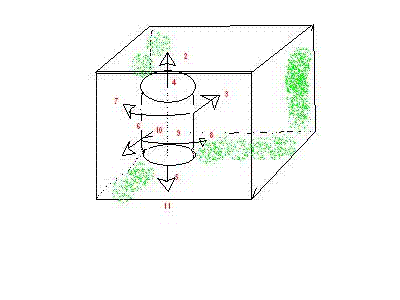
The first image depicted here is an illumination of a bitmap image of a subatomic particle, depicted in eleven dimensions. It is, of course, impossible to depict a real particle with something as crude as a 2-dimensional bitmap canvas.The zeroth dimension was not labelled as it would be quite impossible in this depiction. Neither is the 1st dimension, as the linear dimension is obvious and might actually cause confusion later.Remember that this is a sub-atomic particle being depicted and the sub-atomic space it also occupies or (if correct) creates, distorts, etc.

Dimensions 2 and 3 depict the obvious macroscopic dimensions that we're accustomed to.Dimensions 4, 5 and 6 are "wrapped" around the particle and are "observable" only in the sub-atomic dimension.

Dimensions 7 and 8 describe the spin-direction dimensions of the sub-atomic particle and/or space.

Dimensions 9 and 10 describe the "hidden" spatial dimensions contained inside dimensions 4, 5 and 6.

Dimension 11 describes the space surrounding all the other dimensions, which is timelike.

But, how to prove any of this? We are wracking our brains trying to crack this one....sorry, eleven.Is macroscopic space definded by the interactions of microscopic cells defined by the previous description of a subatomic particle/space?


Is macroscopic space defined by the interactions of these proposed microscopic "cells' defined by the previous description of a subatomic particle? (See above image). Is macroscopic space built-up in this way by microscopic space? Do Planck dimensions have an effect on larger spatial dimensions, including the elucidation of time and timelike curvature in spatial dimensions?

And further still, do the "mysterious" dimensions then "cancel out" and disappear into the known dimensions of space and time (see image below)? Is this how the large scale structure of reality is created?

Tuesday, November 14, 2006

Deletion of Theorema Undecimus

We have had to delete our most recent posting on Blogger due to persistent and insoluble posting and editing problems experienced with Blogger. We have tried to contact the Blogger personnel without success. This has been a serious waste of our valuable time and resources.

Monday, November 13, 2006

Theorema Undecimus


THEOREMA UNDECIMUS

The idea for this theorem (hypothesis, really) came to me on the evening of November 11th, 2006 and considers the eleven "mysterious" dimensions "discovered" by the all-but discarded "String Theory". The editors have no particular adherence to "String Theory", but are very concerned with the shape of space. Particularly, microscopic or "quantum space".

(As usual, we are having problems with Blogger posting any images. The degree of difficulty to even logging onto Blogger has become problematic, even diabolical).

The image to be depicted here was an illumination of a bitmap image of a subatomic particle, depicted in eleven dimensions. It is, of course, impossible to depict a real particle with something as crude as a 2-dimensional bitmap canvas.

The zeroth dimensions was not labelled as it would be quite impossible in this depiction. Neither is the 1st dimension, as the linear dimension is obvious and might actually cause confusion later.

Remember that this is a sub-atomic particle being depicted and the sub-atomic space it also occupies or (if correct) creates, distorts, etc.

Dimensions 2 and 3 depict the obvious macroscopic dimensions that we're accustomed to.

Dimensions 4, 5 and 6 are "wrapped" around the particle and are "observable" only in the sub-atomic dimension.

Dimensions 7 and 8 describe the spin-direction dimensions of the sub-atomic particle and/or space.

Dimensions 9 and 10 describe the "hidden" spatial dimensions contained inside dimensions 4, 5 and 6.

Dimension 11 describes the space surrounding all the other dimensions, which is timelike.

Blogger image of this graphic is to the left? Can't see it? Contact Google - don't even bother trying to contact Blogger.


But, how to prove any of this? We are wracking our brains trying to crack this one....sorry, eleven.

Is macroscopic space definded by the interactions of microscopic cells defined by the previous description of a subatomic particle/space?


(A graphic was to be inserted here, but again, we are anticipating Blogger problems and will attempt to post it%2


Monday, October 23, 2006

Anthraquinone, Copper and the Shape of Space

This article is only a stub (to borrow the parlance from Wikipedia).

Recently, researchers at the UC Riverside have made the discovery that anthraquinone molecules when coated onto a clean copper substrate, self-organize.

We wanted to comment on this sooner, but technical problems with Blogger and developing a suitable graphic, prevented this.

The reason for our concern is this; how does the shape of this self-organizing structure reflect the shape of space at the molecular level? Molecular forces of attraction and repulsion at this scale seem considerable. Do these forces have anything to say about the spatial structure - are molecular structure and spatial structure somehow connected at the molecular level? If so, is this connection due to the quantum forces present in the copper and anthraquinone atoms? Do these forces influence the shape of space - at this level - as in General Relativity?

Notum Bonum: This idea is hardly original. See Physorg.com comments section for August 17, 2006 under this topic.

Sunday, September 10, 2006

The Fine Structure Constant + Homage to Weinberg, Adams and Laughlin

In our last post, we delved into the subject of the "Fine Structure Constant" and just how much can the "FS Constant" deviate before the (our) Universe comes apart and decouples - thus causing the cessation of existence?

Naturally, we resorted to the great works of giants such as Steven Weinberg (see "The First Three Minutes").

In his classic, rigorous physical description of the "Frames" (hence we shall refer to these as the "Weinberg Framework") of the changing nature and temperature of the universe we find that the Universe has been evolving. Hypothesis: If the Planck Temperature (or Universal Temperature) has been decreasing since the first microseconds of the Universe, how has the FS Constant changed over this time.

To determine the dependency of the FS Constant (also known as "alpha"), we used the formula for the so-called Planck Temperature and used it to relate to a "Universal temperature" over the first six (and only) frames of the Weinberg Framework. Using this relationship, we developed an equation to describe the variation in the FS Constant over this time. (See bitmap diagram below).

This equation is dependent if and only if ("iff") the electronic charge, the speed of light, the Gravitational constant and the permittivity of free space are unvarying and unchanging throughout this time.

Using this hypothetical basis, one can "calculate" new values for the FS Constant over the Weinberg Framework first six frames of the Universe since the Big Bang. These will be given in the bitmap chart below:

These are purely hypothetical calculated values for the FS Constant over the Weinberg Framework frames 1 through 6.

Which gave us an opportunity to develop a log equation and graph attempting to demonstrate the relationship of the Planck Temperature/"Universal temperature" over the early time frames of the Universe. See below:

Where y = -6E+63Ln(x) + 3E+64 (Where the "R-squared" value is only a miserable 0.4032, but this is only a trendline analysis and not an actual data-fit curve).

Addendum (as of 9/11/2006): If it is possible that alpha has varied logarithmically over the first several cosmic decades...is this a new definition for inflation?

Was the expansion of the universe exponential as a result of the relatively rapid changes in the relationships of the Fine Structure Constant? This seems paradoxical as the Universe was expanding and cooling at the same time.


Monday, August 07, 2006

137.035999710

The Fine Structure Constant of the Universe

In the Physics/Perspectives section of the 28 July 2006 edition of Science (Vol 313) author David Kleppner (MIT, Dept. of Physics) reports in his article "A More Precise Fine Structure Constant" that the dimensionless quantity (or ratio) known as the fine structure constant has been measured to an uncertainty of 0.76 parts per trillion (B. Odom, D. Hanneke, B. D'Urso, G. Gabrielse, Phys. Rev. Lett. 97, 030801 (2006).


The constant (or ratio) is expressed as given above.

What is intriguing to us about this constant is that if it were different by even a factor of ten, this universe would not exist.

And, this "constant" could not have existed in the time of the Big Bang and for several eons afterward as it is an expression of the relationship between the charge of the electron, the speed of light and Planck's constant. The universe was in a very, very dynamic state of flux during those original times and formative eons. The alpha (fine structure constant) ratio could not have existed in those times and must have formed over the period of time when matter and energy began to cool down and form into baryons, leptons and other distinct particles.

The thermodynamic equilibrium and the entropy of the non-local (or global) universe must have its origins with the background radiation temperature and fine structure constant (ratio) of the universe.

If (big if) the universe is "built" of embedded curved surfaces in a large surface as we suggested in our previous posting(s), the universe will continue to change. Eventually, the current universe may even undergo a phase change and increase the size of the so-called fine structure constant by altering the ratio between the speed of light in the newly forming phase structure of the global universe.

This proposed (hypothetical) change will bring about a universal global cooling or warming of the universe and ultimately affect the charge of the universal electrons. (Not to be confused with the current greenhouse theory of global warming of our planet - this warming is locally confined to our local environment).

A phase change in the global universal phase structure must bring about changes in the Planck constant, electron charge and even relativistic effects related to observations of electron charge.

In other words, even if we were able to do it, traveling along the current spacetime curvature to some future light cone might lead to an abrupt transition in the phase structure of the universe along that boundary curve. Ultimately, observing a future light cone might be catastrophic if one were to observe the future phase change of the universe. Traveling along this spacetime curvature might actually bring the observers in contact with a future, unexpected phase change of the universe. The current fine structure constant might conceivably change beyond its unknown boundaries. The nuclear structure of the global universal material might begin to fly apart.

Time travelers, beware...

Another implication suggested by Kleppner is what are the boundary conditions for this fine structure constant. We do not currently know now nor in the forseeable future.

If the inverse fine structure were to change by as much as 0.000000001 parts or even 0.00000001 parts (say in one of the proposed hypothetical phase change mechanisms above, would the universe retract or fly apart in an abrupt phase change. That is, if by observation a future light cone along the spacetime curvature, would some unsuspecting physicists bring about the end of the universe by altering the fine structure constant to the above mentioned parts. We just don't know.

Future cosmologists and physicists beware...

Thursday, August 03, 2006

Homage to Gauss: Theorema Egregium ("Remarkable Theorem")

The great mathematician Carl Friedrich Gauss once wrote his great theory about the curvature of spaces - the Theorema Egregium ("The Remarkable Theorem"). Gauss wrote how different curved surfaces could not "mate" with each other in simple 3D space.

Does this imply that space is not Euclidean, and is in fact hyperbolic? The implications would be that Omega-zero would be less than one and that space (and the Universe and everything in it) would begin to stop accelerating and begin retracting at some point along the space-time curvature.

It seems that this would be the case if before the (previous) Big Bang, some curved surfaces were to be embedded in the intial spacelike curve/event horizon. The forces created between these different (energy) surfaces would have provided thrust for the intial Big Bang. Dark Energy from the bulk surrounding the incompatible surfaces would have provided further negative energy - or an emerging energy vacuum thus providing the impetus for the expansion and inflation of the universe during/after the (initial/previous) Big Bang.

Fortunately the light cones of either event are beyond our observable event horizon. (Or is this unfortunate?). Traveling along some point on the space-time curvature would theoretically provide us with the vantage point from which to observe this future light cone. Which your author suspects is probably true due to the implications of the Theorema Egregium. Certain curvatures are incompatible and do not meet and match. Eventually, the light cone would become observable along this incompatible stretch of curvature in the space-time curvature and the apparent Euclidean curvature of our observable local space-time geometry.

More to come...? 8/3/06

Sunday, July 30, 2006

Does the Universe Have a Shape?


Does the universe have a shape?

In a few years past, there was some recent interesting theorizing and speculation outlined in a National Geographic article. The shape of the universe was theorized to be like a dodecahedron - or even like a "soccer ball". This determination seems to have been partly made by observations of the CMWB (cosmic microwave radiation background). That is if one could travel outside of the proposed boundaries of the universe, one would see a boundary shape like a dodecahedron.

This sounds a bit like a cosmic Pandora's box. If one were to travel beyond this theoretical boundary, well just what would one find surrounding the dodecahedron? Dark matter? Dark energy? It seems it wouldn't be anything like our "normal" universe to which we are accustomed.

Could this be a true source for the dark (negative) energy of universe that provides for the force for the continuous expansion and acceleration of space? Was this the energy source for the inflation of the universe after the Big Bang?

One could speculate - I suppose - that for an initial singularity to come into existence (and then explode) that there had to be an initial boundary condition created by an event horizon. In this case, an initial event horizon might actually be an open yet spacelike curve. The initial hyberbolic spacelike curve existed outside of a timelike curve. This curvature provided a degree of freedom for the initial event horizon to form.

This one degree of freedom and initial event horizon created the initial singularity from which exploded the Big Bang. Dark energy provided by the negative hyperbolic spacelike curve provided the inflation needed to power the Big Bang. The negative hyperbolic spacelike curve also created an opportunity for energy from the Big Bang to create initial embedded surfaces in the event horizon. These embedded surfaces probably had a positive curvature to bind to the intial negative spacelike curve, creating space. The acceleration created the effect of a timelike curve in the embedding of the new positive curvatures forming in the initial spacelike curve. In essence, these positive curvatures created the new effects of gravity and acceleration in the newly forming space which was to become the universe.

A boundary implied by the initial event horizon implies that the intial space created a growing open universe along with the newly formed forces of acceleration and gravitation.

To be continued...? 7/30/06